

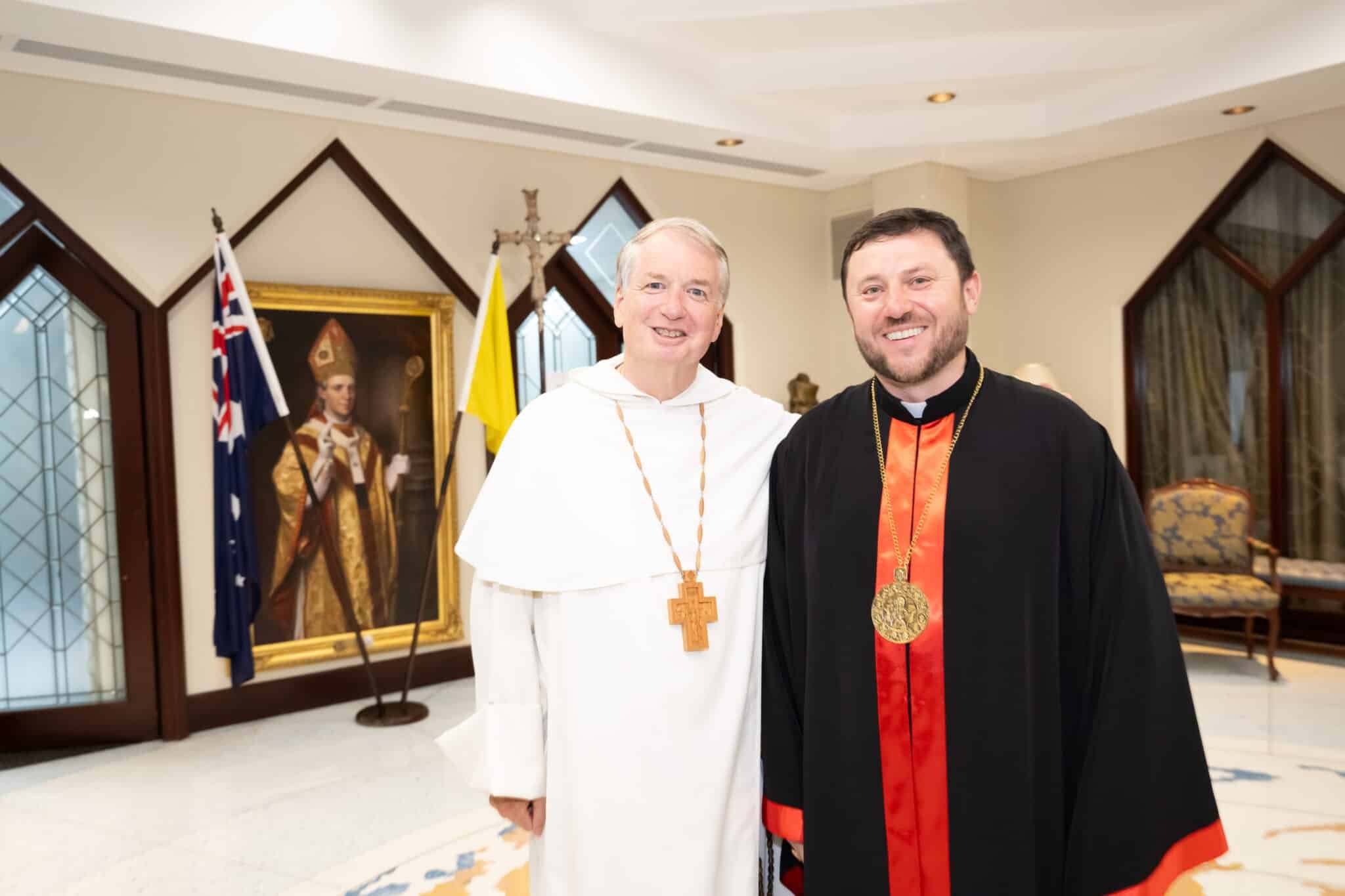
Cardinal Mykola Bychok, Bishop of the Eparchy of Saints Peter and Paul of Melbourne, recently returned to Ukraine to participate in a Synod of Bishops of the Ukrainian Greek Catholic Church. He also spoke with many people in several cities. In his visit to Kherson, he came under fire during a bombardment.
Cardinal Bychok shared his thoughts about his visit to his homeland with The Catholic Weekly.
This year marks the 35th anniversary of Ukraine’s independence. What moral significance does Ukraine’s struggle for freedom have for the world?

Thirty-five years of independence is an opportunity not only to rejoice that we have our own country, but also to remember the price being paid today to defend its freedom. Ukraine is paying a very high price for its freedom and independence.
Thousands of our defenders, men and women, have given their lives for the future of their country, their families and their children. For us, therefore, independence is no longer simply a nice word or a political concept. Behind it are real human lives and immense sacrifice.
What Ukraine is experiencing today already has significance far beyond its borders. Our Church has gained considerable experience in serving people during the war, helping the wounded, prisoners of war, families, and people traumatised by war.
I believe that this experience can also be important for the universal Church. Sadly, there are many wars and conflicts in the world today, and what Ukraine is going through and what we are learning today may, in the future, also be of service to other nations.
Is there an end in sight for the war between Ukraine and Russia? It seems to have reached a stalemate on the front where the only breakthrough will come from terrorising and demoralising the civilian population.
I am not a military expert, so I would not want to make predictions about the situation on the front or say when exactly the war will end. We all long for the war to end and for peace. But peace cannot mean remaining silent in the face of injustice or capitulating to evil. Peace must be founded on truth, justice, and respect for human dignity.

After my recent visit to Ukraine, I can say one thing. For the civilian population, the war has certainly not become something distant or “frozen”. I travelled to different parts of Ukraine. People live under the constant threat of missiles and drones. Homes are destroyed, civilians are killed, and behind every such number is a human life, a family.
Bombs were dropping when you visited Kherson. The strain and tension must be incredible. Can Ukrainians go on fighting after four and a half years of war?
Yes, certainly. When a missile flies over your head and, literally only seconds later, hits the ground and explodes, it is impossible to remain calm.
Yet it was very important for me to travel to southern Ukraine – to Odesa, Mykolaiv and Kherson – because these are areas that are subjected to Russian attacks virtually every day; in some of these cities, the air-raid alerts hardly ever cease.
You know, when we are in Australia, thousands of kilometres away from Ukraine, we can read and speak a great deal about the war, but that is entirely different from seeing this reality with our own eyes. For local residents, missiles, drones and explosions are no longer exceptional events, but a terrible reality in which they are forced to live every day.
Above all, I wanted to go there to be with the people and to show them that they are remembered. The Church must be close to people – not somewhere far away, but alongside those who are suffering, those who have lost loved ones, and those who need a word of hope.
We prayed together, and I had an opportunity to speak with people, including the families of those who have been killed or are missing, and of Ukrainians being held in captivity, as well as seeing the consequences of the attacks. Despite everything they have endured, these people continue to pray and they do not lose hope.
It is difficult for me to say how much longer they will be able to live like this. But after this journey, I understood even more deeply how important it is that they do not feel forgotten. For someone living in such difficult circumstances every day, it means a great deal to know that they are remembered, that people are praying for them, and that even on the other side of the world people continue to speak about Ukraine.
Are you making any progress on the return of kidnapped Ukrainian children?
The return of Ukrainian children remains one of the issues that I try to raise at every opportunity. These children are often deprived of the opportunity to be with their parents and to have access to the Ukrainian language, culture and literature; another history and another identity are imposed upon them.

When Pope Francis presented me with the cardinal’s ring on 7 December 2024, we had a few seconds for a personal conversation, and I asked him to help secure the release of more than 20,000 Ukrainian children who had been forcibly taken to Russia.
To date, just over 2,000 have been returned to Ukraine, more than 100 of them this year. I am very grateful to the Holy See, which is involved in this work, although understandably much of that work cannot be made public.
Is “fake news” an issue in the war? Is the truth about the war reaching Australia and the world?
Yes, fake news is indeed a major problem today. Social media and AI are increasingly being used as tools, including by Russia, to turn truth into lies and lies into truth, making it very difficult for an ordinary person looking in from the outside to distinguish what is true from what is false.
Let me give you a simple example. On the night of 14-15 June, the Russian military struck the 1000-year-old Kyiv-Pechersk Lavra, with a Shahed drone hitting the monastery. I shared photos of the damage on my Instagram account, but the post was hidden from my followers because the social media platform identified it as fake news. In other words, the truth itself was labelled a lie.
In June this year, during a general audience in Rome, I had the opportunity to approach the Holy Father, Pope Leo XIV, and present him with a special gift – a Ukrainian flag and a small wooden cross from Mykhailo Strypa of Hoshiv, a soldier of the 67th Separate Mechanised Brigade “Right Sector”, who served in Nevske, Ploshchanka, Bakhmut, Serebrianske, Chasiv Yar, Dvorichne, Terny and the Sumy region between 2022 and 2025.
Mykhailo entrusted these gifts to Pope Leo with the request that the Pontiff never cease to be a voice of truth in this war.
And you know, I think that this appeal is, in fact, addressed to each one of us as well. One of our most important tasks today is to continue telling the truth about what is happening in Ukraine.
The war has been going on for a long time, and it is natural that the world’s attention shifts from one event to another. That is precisely why we cannot stop reminding people about Ukraine and about those who experience the consequences of this war every day.
I can see that people in Australia are interested in what is happening in Ukraine. I try to use every opportunity – meetings with Church representatives, politicians and community leaders – to speak about Ukraine and to convey the voices of the people I meet.
So I ask you as well: “Let us never cease to be a voice of truth in this war and a voice of truth in this world.”
You went to Ukraine partly to attend the Synod of Bishops of the Ukrainian Greek Catholic Church. The main theme, I understand, was vocations. That’s very encouraging. Is the Church growing in vitality despite the war? Are there conversions?
The question of vocation is extremely important for the life of the Church, because every vocation begins with a person’s encounter with God and with the question: what is the Lord calling me to do?
For me, this is also a very personal subject, because my own vocation developed gradually, beginning in Ternopil, through prayer, participation in the life of the Church, and the example of the priests and consecrated people whom I encountered.
The war has undoubtedly changed people’s lives profoundly and confronted them with many deep questions. Yet even in these circumstances, the Church continues to live and serve. People come to church, they pray, they seek support, and they try to understand how to continue living amid everything they are experiencing.
I would not want to speak about conversions in terms of statistics. Faith is first and foremost a personal encounter between a person and God. But the fact that, even in the midst of war, people continue to seek God, to pray and to trust in Him is, for me, a very important testimony to the life of the Church.
The visit to your childhood home of Ternopil must have been a moving experience for you. What touched you most?
Ternopil will always be a special place for me because I was born there and it was there that my faith was formed. It was there that my parents took me to church, there that I began serving at the altar, and there that I met priests and religious whose example would later play an important role in my vocation.
It was in the Cathedral in Ternopil, on 28 August 1991, only a few days after Ukraine declared its independence, that I made my first confession and received my solemn Holy Communion. Returning there, therefore, always takes me back to the beginnings of my own journey.
This time, however, I returned to a very different Ternopil – to a city and a country living through war.

Particularly powerful for me were the encounters with people whom I know personally and whose families have been directly affected by the war. At the Pantheon of Heroes in Ternopil, I met the mother of one of my former classmates. One of her two sons had been killed defending Ukraine, while the other – my former classmate – has now been listed as missing for more than a year.
When war ceases to be something you merely read or hear about, and you see the pain of people you have known for many years, you experience it in an entirely different way.
For me, therefore, this visit was both a return to the place where my journey of faith began and a deeply personal encounter with what Ukraine is experiencing today.
This is a theological question – you insist on hopeful prayer in the middle of the horror and despair of the war. But what good will prayer do?
After I was appointed a cardinal, relatives of Ukrainian servicemen who are prisoners of war or missing began to approach me, asking for my help in bringing information about their loved ones to the attention of the Holy See, in the hope that this might help them to be found or returned home sooner.
To give you some idea of the scale of this tragedy, today more than 114,000 people in Ukraine are officially listed as missing. Behind this number are not simply statistics, but thousands of fathers, mothers, wives and children who continue to live in the hope that their loved ones will return.
During my time in Ukraine this year, I had several opportunities to meet with the families of those who are missing. One of these meetings took place in the Odesa region.
When I arrived, I was greeted by a corridor formed by mothers and wives, each of them holding a small bell bearing the name of her missing husband, son or father. I do not think I can fully convey what I felt at that moment as I walked through that corridor of terrible, incomparable pain and yet, at the same time, of hope for their return.
You know, it is easy to preach about hope when everything is going well. But how do we speak about hope to those who live surrounded by hopelessness? These people have endured so much, and yet they continue to pray.

For me, this is perhaps one of the strongest answers to the question of whether prayer has meaning: those who are experiencing the war directly bear witness through their own lives that prayer helps them not to lose hope or their trust in God.
You visited the grave of Samuel Pedrazzini, an Australian volunteer who was killed earlier this year. Does Australia’s support make any difference?
Yes, certainly. It was very important for me to visit Samuel Pedrazzini’s grave and pray for him. He was Australian, but he chose to help Ukraine using his military and medical experience. On 13 June 2026, Samuel was killed while carrying out a combat mission in the Donetsk region. In accordance with his wishes, he was buried in Ukraine, in the Alley of Heroes near Ivano-Frankivsk.
His story is particularly powerful because it shows that solidarity does not depend on distance or nationality. A person can see the suffering of another nation and decide that it concerns them too.
That is also how I see the broader support that Ukraine receives from Australia. There is an enormous geographical distance between our two countries, but throughout all these years we have felt that Ukraine is not alone.
And when I prayed at Samuel’s grave, I also prayed for all the other foreign volunteers who did not remain indifferent to the suffering of another nation, who stood in defence of Ukraine and gave what was most precious – their own lives.


